Fixed Rate Savings Bonds UK: The Simple Guide to Locking In Your Best Rate
What Is a Fixed Rate Savings Bond?
A fixed rate savings bond is a special kind of savings account. You put your money in, and the bank promises you one thing that never changes: your interest rate. It stays the same for a set amount of time, like 1 year, 2 years, or even 5 years.
Think of it like a locked box. You put your money in, close the lid, and agree not to open it again until the time is up. In exchange, the bank usually pays you more interest than it would on a normal savings account.
This is why people also call it a fixed rate bond savings account, a fixed term savings bond, or simply a savings fixed rate bond. They all mean the same thing.
Is a Fixed Rate Bond a Savings Account or an Investment?
This is one of the most common questions people ask, and the answer is simple: a fixed rate bond is a type of savings account, not an investment.
Here’s the difference:
- Savings means your money is safe. You know exactly how much interest you’ll get, and your starting amount (called the “capital”) cannot go down.
- Investments, like stocks or shares, can go up or down in value. You might make more money, but you could also lose some.
With a fixed rate savings bond, your money is protected (in the UK, usually by the FSCS, up to £85,000 per person per bank), and your interest rate is guaranteed. So even though the word “bond” makes it sound fancy or investment-like, it works exactly like a savings account with a fixed rate attached to it.
How Does AER Interest Work on a Fixed Rate Savings Bond?
You’ll often see the word AER next to a bond’s interest rate. AER stands for Annual Equivalent Rate. It tells you how much interest you’d earn in a full year if the interest was paid and added back into your account once a year.
Here’s a simple example to show how to calculate it:
- You put £1,000 into a 1 year fixed rate savings bond.
- The bond has an AER of 4.5%.
- At the end of the year, you get £1,000 × 0.045 = £45 in interest.
- Your total balance becomes £1,045.
For bonds longer than a year, the maths is a little different because of something called “compounding” (interest earning interest). But the AER number is designed to make it easy to compare one bond with another, even if they pay interest at different times (monthly, yearly, or at the end of the term).
What Happens to Fixed Rate Savings Bonds When Someone Dies?
This is a sensitive question, but it’s an important one, so let’s answer it clearly and gently.
When the holder of a fixed rate savings bond passes away, the money in the bond doesn’t disappear. It becomes part of their estate. Usually, here’s what happens:
- The family or executor contacts the bank’s bereavement team and provides a death certificate.
- The bank may allow the bond to be closed early without the usual penalty, once proof of death is shown.
- The money (plus any interest earned) is paid out to the estate, following the instructions in the will, or under inheritance law if there’s no will.
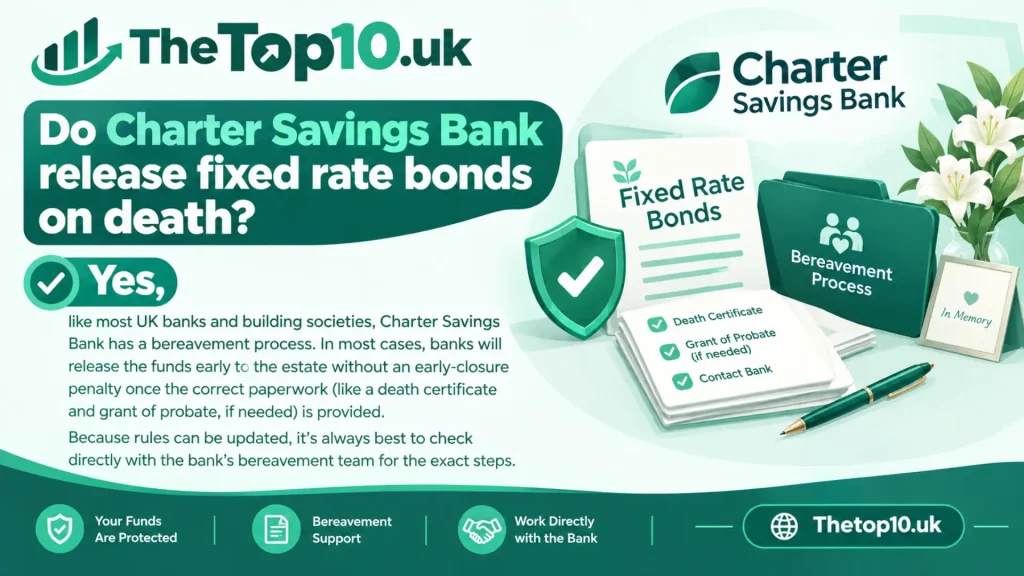
Do Charter Savings Bank release fixed rate bonds on death?
Yes, like most UK banks and building societies, Charter Savings Bank has a bereavement process. In most cases, banks will release the funds early to the estate without an early-closure penalty once the correct paperwork (like a death certificate and grant of probate, if needed) is provided. Because rules can be updated, it’s always best to check directly with the bank’s bereavement team for the exact steps.
Can Hackers Get Into Fixed Rate Savings Bonds?
Like any online account, a fixed rate savings bond can only be reached by someone who has your login details, passwords, or personal information. Banks use strong security, such as encryption, two-factor authentication (a code sent to your phone), and fraud monitoring, to keep accounts safe.
The bond itself isn’t an easy target because you usually can’t move money in and out freely, it’s locked for the term. But scammers sometimes try to trick people through fake emails, texts, or phone calls pretending to be the bank, to get your details. To stay safe:
- Never share your PIN, password, or one-time codes with anyone.
- Only log in through the bank’s official app or website.
- Be suspicious of anyone contacting you out of the blue asking for account details.
Does Tesco Bank Offer Fixed Rate Savings Bonds?
Yes. Tesco Bank offers fixed rate savings bonds (sometimes called Fixed Rate Savers), including 1 year, 15 month, 18 month, 2 year, 3 year, and 5 year options. You lock in a guaranteed rate for the chosen term, and interest is usually paid once a year. tescobank
A quick note: Tesco Bank’s savings accounts are now run by Barclays behind the scenes, but the Tesco Bank name, app, and website are still what you use to open and manage your account.
How to Apply for a Tesco Fixed Rate Savings Bond?
- Go to the Tesco Bank website or open the Tesco Bank app.
- Choose “Savings” and select the Fixed Rate Saver that matches how long you want to save for.
- Check the minimum deposit needed (this is usually a couple of thousand pounds for Tesco’s fixed bonds).
- Fill in your details and confirm your identity.
- Transfer your money in within the allowed window (often the first 30 days).
- Sit back your rate is locked until the bond matures.
Why Is BM Savings Not Offering Fixed Rate Bonds?
BM Savings is the savings brand of Birmingham Midshires, which is part of Lloyds Banking Group (the same group that owns Halifax and Bank of Scotland). For a long time now, BM Savings has mainly looked after its existing savers rather than opening its doors to brand-new customers or launching new fixed rate bond deals.
This is common in banking. A bank might stop offering new fixed rate bonds because:
- It already has enough money deposited and doesn’t need more right now.
- It wants to focus on looking after current customers instead of growing.
- It’s updating its product range and simply hasn’t launched a new bond yet.
If you’re an existing BM Savings customer, it’s best to check your online account or contact them directly, as availability can change.
National Savings and Investments (NS&I) Fixed Rate Bonds
If you want a fixed rate bond backed directly by the UK government, National Savings and Investments (NS&I) offers Guaranteed Growth Bonds and Guaranteed Income Bonds. These are three-year fixed-rate products where your money is 100% secure because it’s backed by the Treasury. They don’t always have the very best rate on the market, but many people like them because the security is as strong as it gets.
How to Find the Best Fixed Rate Savings Bonds?
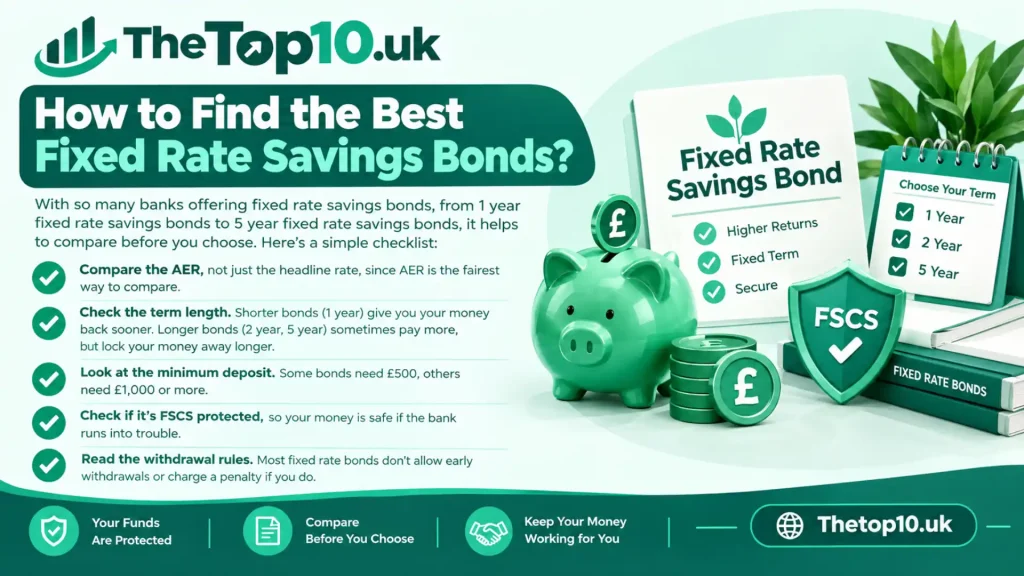
With so many banks offering fixed rate savings bonds, from 1 year fixed rate savings bonds to 5 year fixed rate savings bonds, it helps to compare before you choose. Here’s a simple checklist:
- Compare the AER, not just the headline rate, since AER is the fairest way to compare.
- Check the term length. Shorter bonds (1 year) give you your money back sooner. Longer bonds (2 year, 5 year) sometimes pay more, but lock your money away longer.
- Look at the minimum deposit. Some bonds need £500, others need £1,000 or more.
- Check if it’s FSCS protected, so your money is safe if the bank runs into trouble.
- Read the withdrawal rules. Most fixed rate bonds don’t allow early withdrawals or charge a penalty if you do.
FAQs
What are fixed rate savings bonds?
Savings accounts that pay a locked-in interest rate for a set period of time.
Is a fixed rate savings bond the same as a bond you’d buy on the stock market?
No. A savings bond is a bank account. A stock market “bond” is a different financial product where you lend money to a company or government and can buy or sell it before it matures.
Are fixed rate bonds used for savings or investments?
Savings. Your money is protected, and the return is guaranteed, unlike an investment.
Choosing the right fixed rate bond doesn’t have to be confusing. Head over to The Top 10 UK, where you can compare rates side by side and pick the savings bond that fits your goals.