How to Get a Business Loan in the UK?
By The Top 10 UK editorial team · Information checked October 2026 · General information only, not personal financial advice
Whether you are buying stock, hiring your first employee, or simply smoothing out a patchy cash-flow month, most businesses need outside funding at some point. Knowing how to get a business loan UK lenders will actually approve, comes down to preparation: understanding what you need, choosing the right type of finance, and presenting your numbers clearly.
The UK market offers plenty of routes, from high-street banks and online lenders to government-backed schemes such as Start Up Loans and the Growth Guarantee Scheme. Some suit new founders, some suit established firms, and some are expensive if used carelessly.
This guide explains how business loans work, walks you through the application step by step, and covers startups, small businesses, bad credit, and buying an existing business. Rates, limits, and scheme rules change, so always check the lender’s or scheme’s own website before you apply.
What Is a Business Loan and How Does It Work?
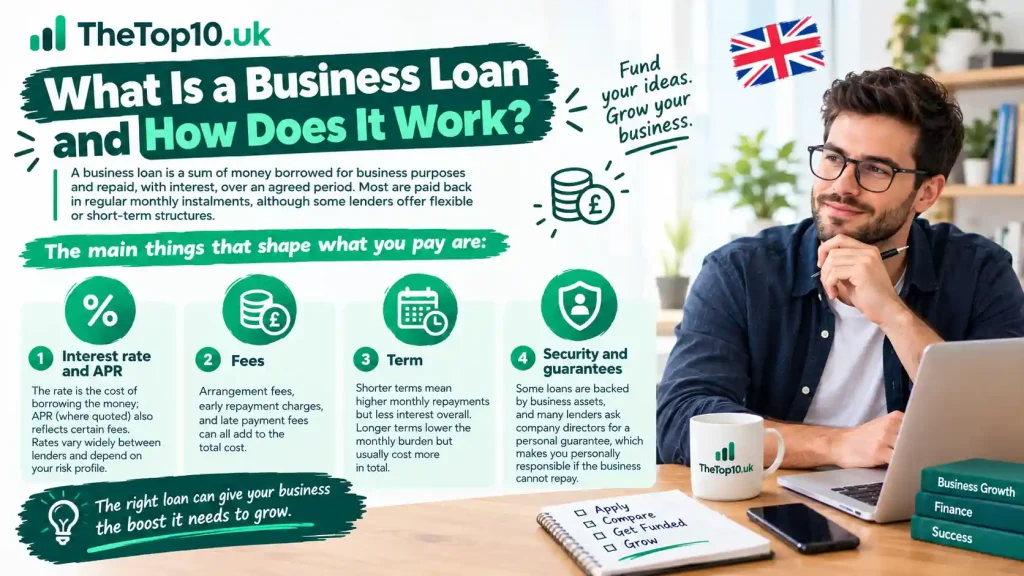
A business loan is a sum of money borrowed for business purposes and repaid, with interest, over an agreed period. Most are paid back in regular monthly instalments, although some lenders offer flexible or short-term structures.
The main things that shape what you pay are:
- Interest rate and APR. The rate is the cost of borrowing the money; APR (where quoted) also reflects certain fees. Rates vary widely between lenders and depend on your risk profile.
- Fees. Arrangement fees, early repayment charges, and late payment fees can all add to the total cost.
- Term. Shorter terms mean higher monthly repayments but less interest overall. Longer terms lower the monthly burden but usually cost more in total.
- Security and guarantees. Some loans are backed by business assets, and many lenders ask company directors for a personal guarantee, which makes you personally responsible if the business cannot repay.
When you apply, lenders typically look at your trading history, turnover, profitability, cash flow, existing debts, and credit history (personal, business, or both), then decide whether the repayments look affordable.
It also helps to know who regulates what. Under the FCA’s rules, lending to sole traders and small partnerships is regulated up to £25,000, while lending to limited companies is not regulated in the same way. That affects the protections available, so ask the lender how your loan is treated.
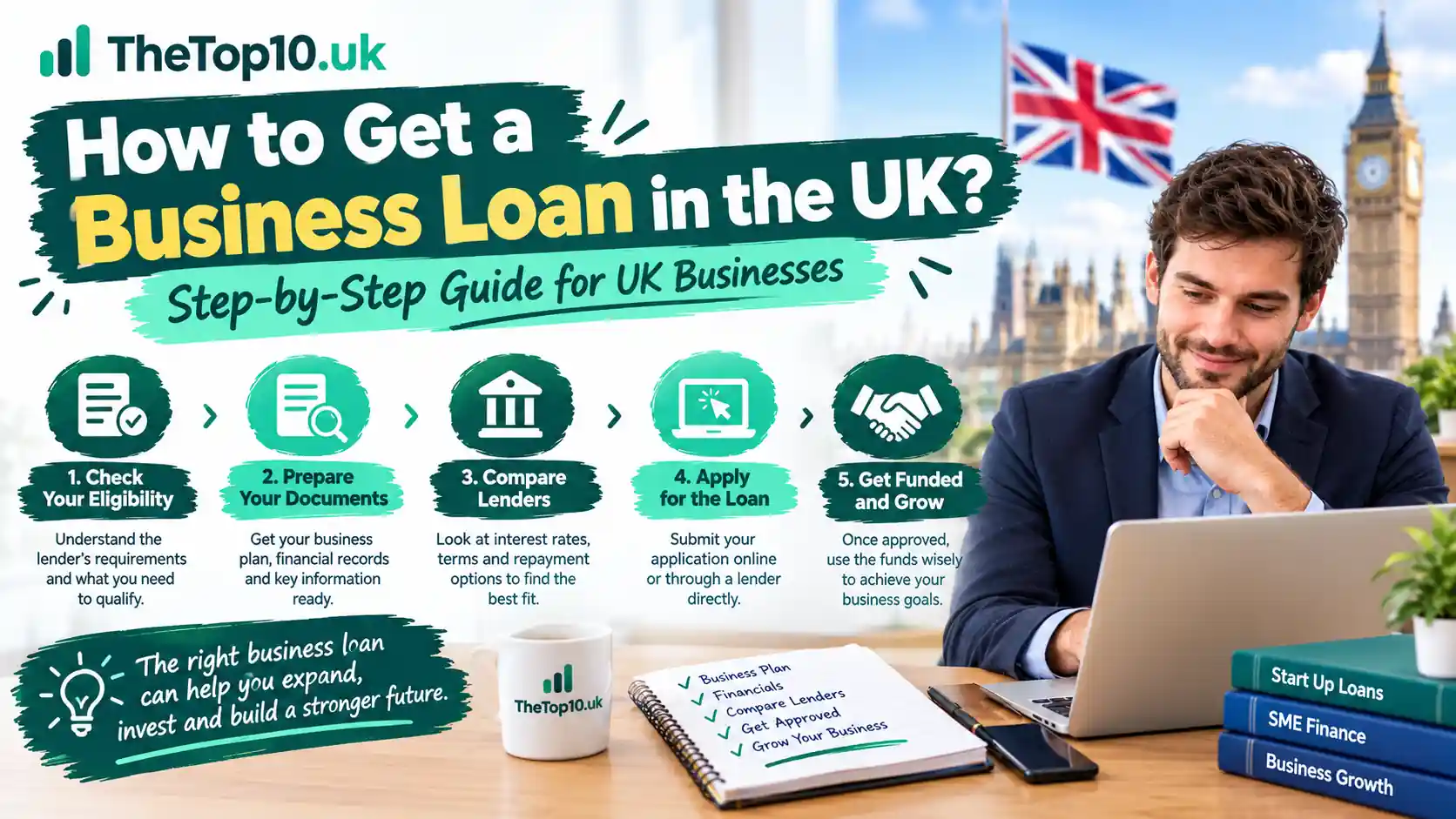
How to Get a Business Loan in the UK: Step by Step
Here is a practical route from “I need funding” to a signed agreement.
1. Work out how much you need
Borrowing too little leaves you short; borrowing too much means paying interest on money you do not use. Build the figure from quotes, invoices, or a costed plan rather than a guess. Add a modest contingency, but keep it realistic.
2. Decide what the money is for.
Lenders want a clear purpose. Buying equipment, bridging a gap between invoices, funding expansion, and buying a business are different needs, and each may suit a different product. A loan tied to something that generates income is generally easier to justify than one covering ongoing losses.
3. Check your personal and business credit history.
Obtain your personal credit reports from the main credit reference agencies, and check your company’s record too. Look for errors, old addresses, missed payments, and accounts that should be closed. Correcting mistakes before applying can prevent unnecessary rejections. MoneyHelper has free guidance on checking and improving your credit file.
4. Compare lenders and finance options.
Look at banks, online lenders, government-backed schemes, asset finance, and invoice finance. Check eligibility rules first, because many lenders offer a soft eligibility check that does not leave a mark on your credit file. Multiple full applications in a short space of time can hurt your score.
5. Prepare a business plan and financial forecasts.
A good plan explains what your business does, who your customers are, how the loan will be used, and how you will repay it. Add a 12-month cash-flow forecast and, for startups, profit-and-loss projections. Be conservative: lenders notice over-optimistic numbers.
6. Gather your documents.
Having everything ready speeds up approval. See the checklist later in this guide.
7. Submit your application.
Fill in the form accurately and consistently. Mismatches between your application and your accounts are a common cause of delays. If you are unsure, ask the lender or a qualified adviser before submitting.
8. Review the loan agreement before accepting.
Read the full terms: total amount repayable, fees, early repayment conditions, security, personal guarantees, and what happens if you miss a payment. If anything is unclear, ask for it in writing. You are under no obligation to accept an offer.
What Are the Different Types of Business Loans in the UK?
Prefer to apply from your phone? Many lenders now let you check eligibility, upload documents, and sign agreements online. If you want to compare app-based options, see our guide to the Best Online Loan Apps UK.
One caution: many loan apps offer personal loans, not business finance. Check whether a product is designed for business use, confirm the provider is on the FCA Register, and compare the total cost before you apply.
Unsecured business loans. No business asset is pledged, which makes them quicker to arrange. Lenders often ask for a personal guarantee instead, and rates can be higher than on secured borrowing. Best suited to smaller amounts, established trading records, and short-to-medium-term needs.
Secured business loans. Backed by assets such as property or equipment. Because the lender takes less risk, you may borrow more or pay less interest, but the lender can take the asset if you default. Suitable for larger sums where you have assets to offer.
Small business loans. A general term for term loans sized for small firms, often from a few thousand pounds upwards. Eligibility usually depends on trading history, turnover, and credit profile.
Startup loans. Designed for businesses with little or no track record. The best-known is the government-backed Start Up Loans scheme (see below). Commercial lenders may also lend to newer firms, but usually with tighter conditions.
Government-backed finance. Schemes like the Growth Guarantee Scheme (GGS) give lenders a partial government guarantee to encourage lending to smaller businesses. You still remain fully liable for the debt, and you apply through an accredited lender rather than directly to the government.
Business lines of credit and overdrafts. Flexible borrowing up to an agreed limit, where you pay interest on what you use. Useful for fluctuating cash flow, but easy to over-rely on.
The right option depends on how much you need, how quickly, what you can offer as security, and how comfortable you are with a personal guarantee.
How to Get a Business Loan in the UK for Startups?
Anyone researching how to get a business loan UK for startups will quickly hit the same obstacle: lenders like evidence, and a new business has little to show. Many mainstream lenders want at least one or two years of trading history, so startups often look to different routes.
Do you need trading history? Not always, but it makes borrowing easier. Without it, lenders place more weight on your business plan, cash-flow forecast, relevant experience, and personal credit record. Founders often have to give a personal guarantee.
Start Up Loans. This government-backed scheme, part of the British Business Bank, offers personal loans for people starting or growing a business. At the time of writing, the details published by the scheme are:
- a fixed interest rate of 7.5% for new applications from April 2026 (the rate was previously 6%);
- up to £25,000 per person;
- repayment over one to five years;
- eligibility extended to businesses trading for up to five years;
- free mentoring and support with your business plan.
It is a personal loan, so you are personally responsible for repaying it, and the decision is based partly on your own affordability. You apply through the scheme’s network of business support partners. Because eligibility, limits, and rates can change, check the official Start Up Loans website before you apply.
Other routes for startups include grants (use the GOV.UK business finance support finder), crowdfunding, angel investment, equity finance, and asset finance for equipment. Personal savings and support from family are common too, though they carry their own risks.
How to Get a Small Business Loan in the UK?
The process for how to get a small business loan UK is similar to the steps above, but the details matter more when you are a sole trader, a micro-business, or a limited company with a small turnover.
Lenders typically assess:
- how long you have been trading and whether you are profitable;
- turnover and the regularity of your income;
- your bank statements to see how cash flows in and out;
- existing borrowing and whether you are already stretched;
- the credit history of the business and of its directors or owners.
Smaller lenders and online platforms often use bank-account data and move faster, while banks may require more paperwork but offer lower rates to strong applicants. Request quotes from several providers, and compare them on total cost, not just the headline rate (see the comparison section below).
A simple example: a café owner wants £30,000 for a new espresso machine and kitchen refit. She has two years of accounts, steady monthly sales, and a clean credit record. She might compare a five-year unsecured term loan with asset finance on the equipment, because the machine itself could act as security and potentially reduce the cost.
How to Get a Business Loan with Bad Credit in the UK?
Searching for how to get a business loan with bad credit UK can feel disheartening, but a poor credit history does not automatically rule you out. It does tend to mean fewer options and higher costs, and no lender can honestly promise approval in advance.
Why credit matters. Lenders may look at your personal credit file (especially for sole traders and small company directors), your company’s credit record, or both. Missed payments, defaults, county court judgments, and high utilisation can all count against you.
What you can do:
- Check your reports for errors and dispute anything incorrect with the credit reference agency.
- Show recent improvement. Clear arrears, keep accounts up to date and avoid new applications for a while.
- Demonstrate affordability. Strong bank statements, steady revenue and a realistic repayment plan reassure lenders more than a perfect score.
- Consider secured finance. Offering an asset may widen your options, but you could lose it if you cannot repay.
- Look at alternatives, such as invoice finance or asset finance, where the lender’s security comes partly from the invoice or the item being funded.
- Ask about a smaller sum or shorter term. A modest request is sometimes easier to approve.
The risks. Lenders serving applicants with weaker credit often charge higher interest, ask for personal guarantees and may offer expensive short-term products such as merchant cash advances. Borrowing at a high cost to cover existing debts can deepen problems. If you are already struggling with repayments, free, impartial debt advice from organisations such as MoneyHelper, StepChange or Citizens Advice should come before taking on more credit.
How to Get a Loan to Buy a Business in the UK?
If you are wondering how to get a loan to buy a business UK, you are looking at acquisition finance, where the loan funds the purchase of an existing business. Lenders will assess both you and the business you want to buy.
What lenders may look at:
- the target business’s financial statements and recent trading performance;
- a realistic valuation, and whether the price is justified by profits;
- evidence that you have carried out proper due diligence (customers, contracts, debts, legal issues, key staff);
- your own experience, plan for running the business and cash-flow forecasts after the purchase;
- how much of your own money you are putting in. Many lenders expect a deposit or contribution from the buyer.
Security and guarantees. Lenders often take security over the business’s assets and may request personal guarantees from the buyer. Be sure you understand what you could lose.
Other ways to fund an acquisition include seller financing (where the seller accepts part of the price over time), investor backing, asset-based lending and, in some cases, government-backed lending through accredited lenders. The Growth Guarantee Scheme can be used for any legitimate business purpose, which may include an acquisition, subject to the lender’s criteria.
Given the sums and legal complexity involved, take advice from an accountant and a solicitor before committing.
What Do You Need to Apply for a Business Loan?
Requirements vary by lender and product, but you may be asked for:
- Personal identification and proof of address for owners and directors.
- Business registration details, such as your Companies House number or HMRC self-employment registration.
- Business bank statements, often covering the last three to twelve months.
- Financial accounts and tax records, including filed accounts, management accounts, VAT returns or Self Assessment returns.
- A business plan and cash-flow forecast.
- Details of existing debts, including other loans, leases and credit facilities.
- Information about collateral, if you are applying for secured finance.
Ask the lender for its specific checklist before you start, so you are not delayed by missing paperwork.
What Credit Score Do You Need for a Business Loan in the UK?
There is no single minimum credit score for UK business loans. Each lender builds its own criteria, and the major credit reference agencies use different scoring scales, so a “good” score with one agency is not directly comparable with another’s.
Two types of record come into play:
- Personal credit history. Particularly relevant for sole traders, partnerships, newer companies and anyone giving a personal guarantee.
- Business credit history. Built from your company’s payment record, filed accounts, county court judgments and the like. Established limited companies are usually assessed more heavily on this.
Lenders also weigh cash flow, profit, sector and security, so a lower score is not always decisive and a high one is not a guarantee. Using a lender’s soft eligibility check can show your likely position without harming your credit file.
Business Loan Providers in the UK
Rather than a ranked list, it is more useful to understand the types of provider and how to check them.
- High-street and challenger banks offer term loans, overdrafts and some government-backed lending. They may offer competitive rates to existing customers with strong records.
- Online and alternative lenders often decide faster and may be more flexible on trading history, though rates and fees can be higher.
- Government-backed schemes such as Start Up Loans and the Growth Guarantee Scheme are delivered through specific partners or accredited lenders. The British Business Bank publishes the list of GGS lenders.
- Brokers and comparison services can help you find options but are not the lender themselves. Check how they are paid and whether they are authorised.
Example: Funding Circle. Funding Circle is a UK business finance platform that is authorised and regulated by the FCA and that says it has worked with the British Business Bank for years, including on GGS-backed loans. Its published information indicates that a personal guarantee may be required from one or more shareholders, that you can make overpayments or settle early without a fee, and that you can check eligibility online before formally applying. Loan sizes, trading-history requirements, terms and fees are updated from time to time and are described differently across third-party sites, so always confirm them on Funding Circle’s own website.
How to research any provider:
- Check it on the FCA Register where relevant.
- Read the lender’s own pages for eligibility, fees and security requirements.
- Look for independent reviews, but treat them as one input only.
- Ask directly about personal guarantees, early repayment and total cost.
- Never pay an upfront fee to “guarantee” approval. That is a warning sign.
How to Compare Business Loans?
A low advertised rate can hide costs elsewhere. When you compare offers, line them up on:
- APR or other disclosed borrowing cost. Make sure you are comparing like with like.
- Interest rate and arrangement fees. A fee taken from the loan reduces what you actually receive.
- Total amount repayable. Multiply it out: monthly payment times number of months, plus any fees.
- Repayment schedule. Fixed monthly payments, seasonal or flexible patterns, and any payment holidays.
- Early repayment charges. Some lenders charge, some do not, and some give only partial interest rebates.
- Security and personal guarantees. What could you lose, and how much of the loan is guaranteed?
- Flexibility and affordability. Could you still meet repayments if sales dipped 20%?
The cheapest monthly payment is not necessarily the cheapest loan. A longer term lowers monthly cost but can raise total interest significantly, so assess the total cost of borrowing, not just the headline rate.
Common Reasons Business Loan Applications Are Rejected
| Reason | What you can do |
|---|---|
| Poor credit history | Check for errors, clear arrears, show recent improvement and consider lenders that look beyond the score. |
| Insufficient cash flow | Provide clear forecasts, reduce the loan size or extend the term so repayments are affordable. |
| Limited trading history | Consider startup-focused routes, bring in security or look at asset finance. |
| Incomplete documentation | Use the lender’s checklist and submit everything at once. |
| Existing debt | Pay down or consolidate where sensible before applying. |
| Unclear business plan | Be specific about purpose, repayment and risks. |
If you are turned down, ask for the reason. Lenders do not always give detail, but understanding the main factor helps you fix it before reapplying. Avoid firing off many applications in quick succession.
Alternatives to a Traditional Business Loan
A term loan is not always the best fit. Depending on your business and the purpose of the money, consider:
- Business grants. Usually do not need repaying, but are competitive and often restricted to specific sectors, regions or purposes. Search the GOV.UK business finance support finder.
- Asset finance. Funds equipment or vehicles, with the asset itself often acting as security.
- Invoice finance. Releases cash tied up in unpaid customer invoices. Useful if you wait 30 to 90 days to be paid.
- Crowdfunding. Raising money from many backers, either as rewards, loans or equity. Works best with a strong story and audience.
- Equity investment. Selling a share of the business to angels or venture investors. No repayments, but you give up ownership and some control. Schemes like SEIS and EIS can make this attractive to investors.
What suits you depends on your stage, sector and appetite for sharing control. A qualified accountant can help weigh the options.
FAQ’s
How can I get a business loan in the UK?
Decide how much you need and why, check your credit reports, compare lenders and schemes, prepare a business plan and documents, apply, and review the agreement carefully before accepting.
Can I get a business loan with bad credit in the UK?
Possibly, but options may be more limited and more expensive. Lenders consider cash flow and affordability as well as credit history. Approval is never guaranteed.
Can I get a business loan for a startup with no trading history?
Some routes exist, such as the government-backed Start Up Loans scheme, but you will normally need a solid business plan, forecasts and a good personal credit record. Many commercial lenders require trading history.
How much can I borrow for a small business?
It depends on the lender, your turnover, profitability and credit profile. Start Up Loans offer up to £25,000 per person; the Growth Guarantee Scheme allows facilities up to £2 million per business group through accredited lenders; other lenders set their own limits.
Do I need a business plan to get a business loan?
Most lenders will want to see one, especially for startups or larger sums. Established businesses may be able to rely mainly on accounts and bank statements, but a clear plan still helps.
Can I get a business loan as a sole trader?
Yes, many lenders lend to sole traders, though they usually assess your personal credit and income closely. Lending to sole traders up to £25,000 falls under FCA regulation.
Can I get a loan to buy an existing business in the UK?
Yes, acquisition finance exists, but lenders will examine the target’s accounts, the valuation and your own experience, and often expect a deposit and security or guarantees.
Are there government-backed business loans in the UK?
Yes. The Start Up Loans scheme and the Growth Guarantee Scheme are both run by or through the British Business Bank. You apply via their approved partners or accredited lenders, and you remain liable for the debt.
How long does a business loan application take?
It varies. Some online lenders can decide within days, while banks and government-backed schemes may take longer, particularly if documents are missing.
Can I get a business loan without providing security?
Yes, unsecured loans exist, but lenders may ask for a personal guarantee instead, and rates can be higher. The Start Up Loans scheme is currently described as unsecured and without a personal guarantee, though it is a personal loan.
Conclusion
Learning how to get a business loan UK lenders will say yes to is mostly about preparation. Know exactly what you need and why, check your credit files, build a credible plan and gather your paperwork before you apply. Compare several providers on total cost, not just the headline rate, and read every term, especially anything about personal guarantees and security.
Most importantly, borrow only what you can comfortably repay, even if sales dip. A loan will not fix a business model that is not working, and no lender or guide can promise a particular outcome.
The Top 10 UK is here to help you research financial products and make informed decisions. We do not provide loans or personal financial advice, so consider speaking to a regulated adviser or accountant if you are unsure.
Sources and further reading (please verify before publication):
- Start Up Loans: https://www.startuploans.co.uk
- British Business Bank, Growth Guarantee Scheme: https://www.british-business-bank.co.uk/finance-hub/
- GOV.UK, Business finance support finder: https://www.gov.uk/business-finance-support
- MoneyHelper, Credit reports and scores: https://www.moneyhelper.org.uk
- FCA Register and guidance: https://www.fca.org.uk
- Funding Circle UK: https://www.fundingcircle.com/uk/